Sunday, January 24, 2010

EVOLUTION AT WORK - THE HAWKMOTH & THE TOBACCO PLANT


A fascinating study was published last week in Current Biology about the relationship between the hawkmoth and the Coyote Tobacco plant, Nicotiana attenuata. N. attenuata is wild flowering plant found in the west, related but not the same as the cigarette tobacco plant grown in the south. (You may recognize it as a relative of the Nictiana plant that is a favorite perennial in New England gardens). The plant has developed - as many flowering plants have - a symbiotic relationship with its pollinator, the Hawkmoth. The moth picks up and disperses the plants pollen. The the benefit to the moth is that it frequently lays its eggs on the plant's leaves. When the eggs hatch, its larvae (the caterpillars) have their first meal - the plant itself.

This is obviously not a mutually beneficial relationship. Too many caterpillars and the tobacco plant population would begin to drop, and possibly disappear. The plant faces a choice: adapt or die.

Scientists has recently observed a startling adaptation taking place. The plant normally flowers in the evening hours during Hawkmoth high flight times. Recently, however, the tobacco plant has begun to flower during the morning, attracting a new and different pollinator: a hummingbird that has no interest in devouring its provider of nectar.

This is evolution at work. The plant has a choice in a figurative sense. It doesn't have a working brain capable of strategizing a plan for its own survival. There is something more primitive at work. Something elegant in its simplicity, and powerful in its determination: natural selection.

Natural selection, one of Darwin's main ideas in his theory of evolution is commonly thought of as "survival of the fittest". It refers to the fact that there is a great deal of variation within a population or organisms, in this case the tobacco plants. Most of the plants flowered at night and had a higher likelihood of being eaten by Hawkmoth larvae. A few plants, flowered earlier in the day. The earlier flowering plants survived, thrived, and passed their genetic code on to the subsequent generation of plants. They're the ones who had higher survival rates. The balance shifted between night flowering plants and morning flowering plants shifted towards to morning plants.

Interestingly though, the night flowering plants remain. Scientists hypothesize that the moths, which fly over a much larger territory, are superior pollinator and capable of spreading the plant's pollen to plants further away than the hummingbirds are able to.

Regardless - more and more of the tobacco plants began to flower in the early morning hours. This adaptation gave the population of tobacco plants the opportunity to recover and stablilize, ultimately strengthening this new trait that aids their survival. The species has changed. It has adapted to thwart a negative force in its environment.

It has evolved.

Tuesday, January 5, 2010

THE $177,000 TUNA FISH


This ties in perfectly with the ideas and themes we have recently been discussing: humans want what they want when they want it.

The New York Times reported yesterday that a large (513 pound) blue fin tuna was caught and sold in Japan recently. How rare is a catch like that in today's depleted ocean waters? Rare enough to be worth $177,000 to a couple of sushi restaurants.

Here's what was reported:

"TOKYO (AP) -- A giant bluefin tuna fetched 16.3 million yen ($177,000) in an auction Tuesday at the world's largest wholesale fish market in Japan.

The 513-pound (233-kilogram) fish was the priciest since 2001 when a 440-pound (200 kilogram) tuna sold for a record 20.2 million yen ($220,000) at Tokyo's Tsukiji market.

The gargantuan tuna was bought and shared by the owners of two Japanese sushi restaurants and one Hong Kong-based sushi establishment, said a market representative on condition of anonymity because he was not authorized to disclose the information.

Caught off the coast of northern Japan, the big tuna was among 570 put up for auction Tuesday. About 40 percent of the auctioned fish came from abroad, including from Indonesia and Mexico, the representative said.

Japan is the world's biggest consumer of seafood with Japanese eating 80 percent of the Atlantic and Pacific bluefins caught. The two tuna species are the most sought after by sushi lovers.

However, tuna consumption in Japan has declined because of a prolonged economic slump as the world's second-largest economy struggles to shake off its worst recession since World War II.

''Consumers are shying away from eating tuna ... We are very worried about the trend,'' the market representative said.

Apart from falling demand for tuna, wholesalers are worried about growing calls for tighter fishing rules amid declining tuna stocks.

The International Commission for the Conservation of Atlantic Tunas in November slashed the quota for the 2010 catch by about one-third to 13,500 tons (12,250 metric tons) -- a move criticized by environmentalists as not going far enough."

What to you think? Is cutting the quota for 2010 by one-third enough? Or should we do more?

Sunday, December 6, 2009

AMUR AMOUR


A baby Amur leopard was born last month in Serengeti Park in Hodenhagen, Germany. She made her first public appearance on Friday December 4.

Amurs, or Far East leopard have some very interesting characteristics. While their summer coats are about 2.5 inches long, their winter coats grow to 4 inches. A beautiful animal with widely spaced rosettes (“spots”) with thick border, Amurs have been reported to leap nearly 20 feet horizontally and 10 feet vertically in their pursuit of prey.

Unlike the better known African leopards, Amur leopards live in the temperate forests of Russia’s far eastern regions. Nearly 80% of their natural habitat has been destroyed during the past two decades. As a result, Amur leopards are critically endangered. It is estimated that less than 40 remain in the wild. At last count, there were 34.

Zoos may represent the last, and best hope, of preserving this magnificent species. This means that the final survivors will live in captivity.

Zoos often lead to conflicting thoughts and feelings in people. I know this is something some of us discussed during our visit to the Bronx Zoo. Given the critically endangered state of the Amur leopard – and other aniamals – what role do you think zoos should play in their preservation? Should the animals be placed on public display? Should they be maintained separately in more “respectful” environments?

Or should the last remaining members of the species be allowed to die in dignity in the last remaining vestiges of their natural environment?

Monday, November 30, 2009

BAD ECONOMY GOOD FOR GATORS


"Crocodile rockin' is something shocking, and your feet just can't keep still..." Elton John

Especially in those Crocs, made of real Croc. Get 'em while you can.

The New York Times reported that the downturn in the economy has had an unanticipated consequence on alligator farming. Sales of products that use alligator skin are down. Fashionistas who may have spend upwards of $12,000 on an alligator skin wristwatch strap in the past, are now hesitating. Times are tough all over I guess.

Alligator farming is tightly regulated by the US department of Wildlife to maintain a wild population of one to two million. Farmers must raise the alligators from birth, meaning that eggs have to be taken (stolen) from angry gator mommas in swampy areas who are fought off with long poles. The babies are expensive to raise, and as they get larger they frequently bite each other. Bites make their skin relatively worthless ("Yes madam, that is a scar on that handbag - hmm... perhaps I can let that one go for less, say, $5,000?"). Few make it past four feet in length before they are slaughtered.

Men enter the tanks and kill the gators with a quick, sharp stab through the head into the brain. The alligators are skinned, their meat is sent to restaurants and pet food manufacturers. For years, their skins were sent to one of about a dozen tanneries around the world that specialized in processing the leather of reptile "exotics" for fashion houses such as Hermes, Cartier, and of course, Gucci.

During the past decade, the fashion house Hermes has been buying many of the exotic tanneries. Hermes has fought for lower prices for the skin from farmers - often at prices below the cost of raising the alligators. At the same time, they have raised the market prices of tanned hides to ridiculously high levels. That "buy cheap, sell high" business strategy, in combination with the economic recession, has created a crash in the market for alligator goods. As one buyer for Neiman Marcus, the high end department store, is quoted as saying: "‘I’m not going to spend $4,000 for an alligator shoe.’ (Gee, and I thought I was the only one who thought such a thing.)

High prices, and the economic recession, have caused sales of alligator skin fashion accessories to fall dramatically. That's good for the gators, but not for the small farmers who raise them. Despite recent signs of an economic upturn, many alligator farms are closing do to losses of upwards of $15,000 a month. One farmer is opening up a tourist zoo along the highway. Others are leaving the industry altogether. It's hard to continue working on a farm that loses money while growing a crop that can bite your arm off.

I'm sure many of us wandered the dinosaur halls of the American Museum of Natural History thinking about how cool it would be if Jurassic Park were a reality. To be able to see the living, breathing bodies that brought movement to those fossilized bones we observed with wide eyes and slackened jaws. After reading this article, however I'm glad the big guys went extinct. It's both sad and demeaning to think how they too, would have wound up as fashion accessories.

"A T-Rex handbag, madame? Or perhaps I can interest the gentleman in a matched set of Stegosaurus luggage?"

We've had benefit concerts for farmers called "Farm Aid". Maybe its time for a benefit concert to help preserve the alligator population. We'll call it (pinky to mouth) - - - - Gator Aid.

Sunday, November 22, 2009

PLASTIC GARBAGE PART 2


I hope you had an enjoyable weekend. I know I did. I went down to Boston to visit my son at school, and spent the night with my sister before we get together again this week for Thanksgiving.

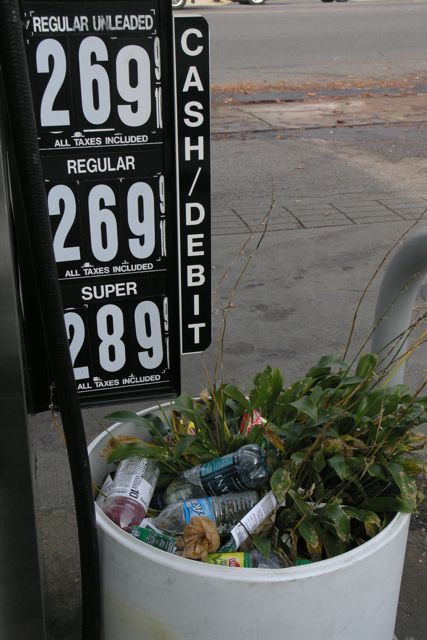
I stopped for gas on the way out of Boston, on Boylston Street, right outside of Fenway Park. I took this photo while I was pumping my gas. The image of plants of questionable health surrounded by an island of plastic bottles was pretty disturbing. Particularly because some trash cans were readily available just to the left of the pump. Add to that the gasoline price chart hovering over it all - reminding us of the ugly side of fossil fuels, and the use of oil in the manufacturing of plastic. (In fact a study out of Sweden suggest that there is a strong link between the use of oil to manufacture plastic and global warming - everything is interconnected.)

I think we all felt a little overwhelmed last week when we discussed the floating island of trash in the Pacific. There was this sense of impotence; what could we, as individuals do about a problem so vast and so distant? This little mess made me realize - more that ever - that we truly can make a difference through small, individual actions. After taking the picture, I disposed of the trash in the container. On the drive home, I stopped along I89 to pick up some trash someone had thoughtlessly tossed out of their car. These are small actions all of us can do, to make our immediate environment a little nice, a little cleaner, and a little more beautiful.

Keep this in mind the next time you see a scrap of paper, or a wrapper of some kind lying on the ground somewhere around our beautiful campus. Don't take the beauty that surround us for granted. Be a part in maintaining the beauty of your immediate surroundings.

This action may not seem as dramatic as cleaning up the Pacific Ocean. But it will have an immediate, noticeable impact on our little community and environment. And who knows - if you spread the word, perhaps a new movement will be born.

Sunday, November 15, 2009

THE PACIFIC OCEAN: THE WORLD'S GARBAGE DUMP


There is a stretch of "plastic-soup" that starts about 500 miles off the California coast, and continues west past Hawaii, extending nearly to Japan. Covering a length of ocean nearly twice the size of the United States, and in places nearly twice the size of Texas in width, this plastic island - not quite thick enough to walk on, but thick enough to serve as a raft of sorts - is made up of our plastic garbage. Gallon milk jugs, plastic wrappers, plastic shells that surround virtually every product we buy - millions of tons of plastic, held in place for the ever moving ocean currents.

For us, it's out of sight, out of mind. But not for the wild life.

Enter Chris Jordan. Jordan is a nature photographer "best known for his large-scale images of excess, rendering unimaginable statistics like the millions of pieces of plastic dumped into the ocean each hour". Pictured above is one image from Jordan's photo essay on the effects of the plastic dump on the birds of the Midway Atoll - an island located in the center of the Pacific garbage patch. I suggest you double click on the image to get a really good look at it.

The birds on the island eat the plastic, perhaps mistaking the fragments for the floating bells of ocean jellies ("Jellyfish"). Inevitably, the plastic clogs their esophagus, their gut, and digestive tract resulting in the birds' deaths.

Jordan's photo essay documents the decaying bodies of the birds, without moving a single feather - recording their final image just as he finds them on the island. Decaying flesh amidst a whorl of feather and hollow bone, and a body full of plastic.

To put this in some kind of perspective, you should know that this island is located in the middle of a remote marine sanctuary, dedicated to the preservation of marine life. It is located about halfway across the ocean. The closest continental land is approximately 2,000 miles away.

You can't get much further from human presence than this spot in the middle of the Pacific Ocean.

Yet there we are. The Human Stain. Our signature, found in the middle of a dead baby bird, on a remote island, in the middle of the Pacific Ocean.

Koyaanisqatsi.

Sunday, November 1, 2009

LIVES OF A CELL


Sophomores read Lewis Thomas' classic essay Lives Of A Cell this weekend. In this essay, Thomas reflects on the precise mechanism of cell dynamics - how the structure of molecules and organelles relates to their specific functions.

At the end of the essay Thomas jolts the reader with a question that initially seems preposterous: Is our planet, the earth, most like a single self-contained cell?

Is it a question of proportion? Are the organisms that inhabit the biosphere analogous to the molecules and organelles that transport, communicate, package, send, receive, read, translate, tranmit, decode, and create new material within the cell?

Is it all merely a question of scale and frame of reference? Are we the fleas on the elephant - incapable of seeing the whole resulting from the sum of its parts?

Sophomores typically find it a difficult concept to fathom. The earth? A cell? How can that possibly be?

Watching this video, in which digital animation recreates some familiar structures and functions of a cell - reading the genetic code, building proteins at the ribosome, the Golgi packaging the proteins in vesicles, moving these proteins through the cell membrane, and transporting them throughout the body - made me think once again of Thomas' koan (mind puzzle). For if the earth is indeed a single "cell" in a macro-universe, what is the the entire "organism"?

What hope is there for us to see, let alone comprehend, the elephant as a whole? And if we do, will we understand it, or will it forever be a mystery?

I look forward to reading your reflections on this.